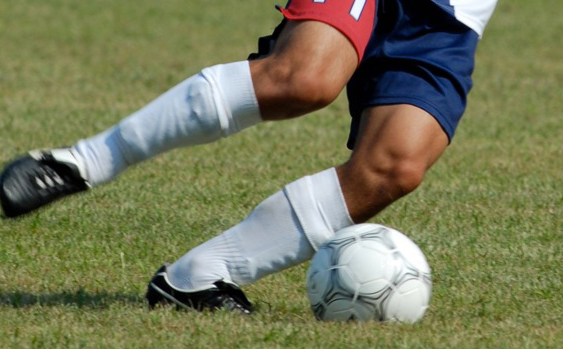
Although lower leg injuries can occur in all athletes, there is evidence that deep cleats, such as those used by soccer players, may dramatically increase the likelihood of severe non-contact injuries such as ACL (anterior cruciate ligament) tears of the knee.
The Scientific Evidence
Concerns regarding the shoe-surface interface are backed by growing biomechanical research and clinical studies:
Rotational Traction & Torque
It is not only recent news, such as NFL players who are blaming infilled artificial turf for their injuries. The American Journal Of Sports Medicine, in an article published March 5, 2009 entitled, "Football Playing Surface and Shoe Design Affect Rotational Traction," concluded that infill artificial surfaces exhibited significantly greater rotational traction characteristics than natural grass.
ACL Strain Measurements
A January 2010 study published in the Journal of Biomedical Engineering entitled, "The Effect of the Shoe-Surface Interface in the Development of Anterior Cruciate Ligament Strain," evaluated exactly how forces travel up the legs of athletes.
Collegiate & Institutional Player Data
In a rigorous study tracking performance and injuries among college players, researchers found a significantly higher rate of ACL and lower leg injuries on infilled artificial turf compared to grass surfaces. This is consistently corroborated by medical tracking groups, including published literature showing that overall athletic injury incidence is fundamentally higher on artificial turf surfaces.
What's Involved in ACL Surgery?
The Mechanics: It Is Not a "Repair"
In a complete ACL tear, the short, stubby ligament in the back of the knee is permanently destroyed. Thus, an "ACL repair" is not really a repair at all, but rather a "re-creation."
In children, most often the orthopedic surgeon will harvest part of the patellar (knee cap) tendon, along with a small portion of bone at each end of the tendon. These bone ends are then sewn back into the original ACL tendon insertion locations. In adults, the tendon is often harvested from cadaver donors.
The Recovery Timeline & Reality
Recovery from ACL surgery is a long and painful process, especially for children and teens. The knee is completely immobilized at first by a rigid brace. Subsequently, special machines are required which passively increase the range of motion. Hours of physical therapy are then required.
Although ACL surgery is now widely performed through small incisions, the harvesting of the patellar tendon requires a large incision, and the procedure demands general anesthesia. To minimize these scenarios, sports clinics emphasize proactively addressing turf versus grass field variables for sports injury prevention.